 |
 |
 |
Loading...
Searching...
No Matches
| |
|
|
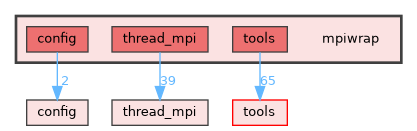
Directories | |
| config | |
| thread_mpi | |
| tools | |
Files | |
| fallbacks.cpp | |
| internal.h | |
| launcher.cpp | |
| loader.cpp | |
| mpi-functions.h | |
| mpi-types.h | |
| mpi.h | |
| mpiwrap.cpp | |
| mpiwrap.h | |
| tmpi.cpp | |
| types.h | |
This module lets one PLUMED kernel use MPI through an explicitly selected runtime while preserving the existing Communicator source interface. Native MPI builds keep PLUMED's existing direct MPI path. Serial-built kernels can load an external MPI provider at runtime and optionally include embedded thread-MPI. The embedded runtime uses the pinned GROMACS implementation and starts only when the explicit internal launcher is used.
This separation also enables smaller package build matrices: one plumed package can serve MPI-independent users and users of either external MPI implementation, with small optional plumed-mpi provider packages. See Packaging and conda extensions.
Native MPI is discovered through –enable-mpi (enabled by default). Internal thread-MPI defaults on when native MPI is unavailable; use –disable-thread-mpi to turn it off. Explicitly requesting both available providers is an error. Building embedded thread-MPI does not make it an implicit serial fallback: launch it explicitly with –tmpi-threads N. –disable-mpi –disable-thread-mpi builds a kernel with neither MPI runtime linked in; injection and runtime provider loading remain available.
__PLUMED_HAS_MPI means native MPI only. __PLUMED_HAS_THREAD_MPI means the internal runtime is built. __PLUMED_MPIWRAP is always defined by configure: availability of the wrapper frontend is separate from selecting a provider. Native MPI still uses its actual handle types and direct calls. plumed config has mpi reports whether native or internal thread-MPI was enabled at build time; real_mpi and thread_mpi report those build choices separately. Loading a provider does not change this configuration record. The CLI provides –has-mpi for combined runtime capability, –has-real-mpi for a native build or a selected real-MPI provider, and –has-thread-mpi for available internal thread-MPI (or a selected thread provider). Both capabilities may be true. –mpi-ranks-are-threads describes only the selected provider, independently of initialization; CHDIR safety uses the separate initialized-provider runtime check. Capability queries do not select embedded tMPI or initialize MPI. An explicitly configured environment provider may be selected for a query. Real-MPI initialization and finalization belong to the executable or host application, never the serial-built PLUMED kernel. Host injection is tested by a separate MPI program. The regression runner preserves old test settings and native launcher overrides; older executables without thread-MPI support retain their native MPI launcher.
Provider-mode Communicator construction does not evaluate MPI_COMM_SELF or select a provider. Its default handle is explicitly unresolved until an MPI operation; SELF is resolved after the selected provider is initialized. Provider selection and initialization are separate; serial operations still use local fallbacks until MPI is initialized, including in builds without embedded thread-MPI. Importing a native communicator without an injected or environment-selected provider first looks beside the loaded kernel for libplumed-mpi-provider.so (libplumed-mpi-provider.dylib on macOS). If absent, it triggers mkmpi without a --compiler option to build the native adapter. It searches $MPICC, $MPICXX, mpicc, then mpicxx. This search must find a compiler compatible with the host MPI runtime. The kernel never initializes or finalizes real MPI. The --mpi-ranks-are-threads query succeeds only when a thread-based provider has been selected. The package mpiwrap/mpiwrap.h inquiry reports whether an installed, initialized provider executes ranks as threads; the PLUMED action uses it for CHDIR safety.
All C++ implementation types, functions and state live under PLMD::mpiwrap, including mpiwrap::provider_installed(), the registry and mpiwrap::pointers. Native MPI-name macros forward to this namespace. Standard MPI type aliases remain available for unchanged callers. The C-compatible adapter and descriptor use conditional namespace guards: C++ definitions are in the module namespace, while C99 compilation and exported C symbol names are preserved. The public plumed_mpi_implementation spelling remains available through a using-declaration. Imported runtime definitions and its test helpers are under PLMD::thread_mpi; executable entry points remain global.
Declaration-only/inline headers declare PLUMED_HEADER_ONLY, and shared C headers declare PLUMED_C_COMPATIBLE, using the generic plumedcheck rules. Neither property relaxes namespace or guard checks. No mpiwrap-specific plumedcheck suppression is used.
In provider mode, each public MPI handle is a trivial, standard-layout POD record. Its zero-filled storage starts at offset zero and holds the native handle representation. This is a deliberate compatibility contract: existing PLUMED callers can keep passing &Communicator::Get_comm() to nested kernels without changing their source or creating export buffers. A compatible receiver copies exactly the selected provider's reported native handle size from that address into zero-filled wrapper storage. The storage capacity is validated before use. Matching bytes do not make a handle valid across unrelated MPI runtimes.
The wrapper and native adapter communicate through a versioned C-compatible provider descriptor. Injection uses the existing command interface, advertised by getApiVersion >= 13; the kernel symbol table remains version 4. The provider descriptor has its own ABI version. Fixed entry layouts are frozen within a provider ABI major; new optional capabilities use named metadata entries. Each injected implementation takes one pointer per argument plus a result-storage pointer, following the draft; there is no array of argument pointers. Function pointers use a generic function-pointer carrier and are cast back to the exact generated per-function transport type before invocation. IDs are hashes of function names used for validation, never addresses or table offsets. Entries append contiguously in array order, including conditional entries. PLUMED handles native storage, array strides and status conversion; injected implementations call native MPI. The nullable description is copied at installation for diagnostics only. ranks_are_threads describes execution; absence of a function means unavailable.
PLUMED_MPIW_HANDLE_CAPACITY defaults to max(8, sizeof(void *)); PLUMED_MPIW_STATUS_CAPACITY defaults to 128 bytes. Rare overrides can be supplied as compiler definitions, for example -DPLUMED_MPIW_HANDLE_CAPACITY=24 -DPLUMED_MPIW_STATUS_CAPACITY=192. Use the same definitions for the kernel and every client using wrapper types, and rebuild them together. Installed headers retain the defaults; configure does not select or propagate these overrides. Native MPI's direct types are independent of these capacities, as is the thin native provider; provider installation checks that its native values fit the receiving kernel. Handle storage is a zero-filled byte-array POD. Provider ABI major 3 uses fixed per-function pointer transport and rejects older incompatible provider layouts before reading their entries. Providers must fit those configured representations, and installation validates the capacities and native scalar metadata before publishing function pointers. The frontend signatures follow MPI-5 const correctness. The native adapter keeps any compatibility cast for older native headers local to an input-only MPI call; callback types and writable arguments retain their exact types.
Internal thread-MPI launching uses the ordinary command interface: configure CLTool arguments, including --tmpi-threads N, and execute CLTool run. The initial PLUMED object dispatches the launch; each rank constructs its own tool and communicator state. No public kernel-handle type or separate launcher function is needed. The kernel owns internal worker startup and finalization. Nested/concurrent launches are rejected. Sequential reuse with different rank counts must be covered by the maintained launcher check. An unrecoverable rank exception terminates the process rather than unwinding through blocked peers; recoverable errors use the existing command exception translation.
Standalone C++ programs can use the internal mpiwrap::launchRanks entry declared in mpiwrap.h. CLTools uses this same entry for internal launch. Select internal_thread_mpi for embedded workers, or standalone_owned for a native-MPI program launched by mpiexec; the latter initializes MPI, checks the requested process count, executes one callback per process, then finalizes. host_owned requires already initialized native MPI and never initializes or finalizes it. The supplied native communicator bytes are valid during the callback; construct rank-local objects there. This is an internal C++ facility, not a new Plumed.h or symbol-table API.
C++ make regtests opt in with plumed_mpi_harness=yes and a positive mpiprocs in config. The runner passes -n N to the executable and uses mpiexec -np N ./exe -n N for direct MPI or ./exe -n N for internal tMPI. The executable parses -n and calls the shared launcher. Existing make tests keep their previous behavior. regtest/basic/rt-mpiwrap-launcher is a four-rank launcher smoke test; regtest/basic/rt-mpiwrap-api provides the mapped-API checks.
When the host needs to inject the MPI implementation already used by its MD code, define __PLUMED_WRAPPER_MPI_HOST_ADAPTER=1 in each host translation unit before including Plumed.h. This embeds the host adapter independently of the wrapper implementation, so the host can link normally to libplumed. Define __PLUMED_WRAPPER_IMPLEMENTATION as well only when embedding the wrapper implementation, for example for runtime loading. Include the host MPI bindings first. For GROMACS thread-MPI, include thread_mpi/mpi_bindings.h first and ensure GMX_THREAD_MPI has its numeric build value. Include gromacs/version.h so GMX_VERSION is available, or explicitly define __PLUMED_WRAPPER_MPI_GROMACS_VERSION using the same numeric encoding (2026.0 is 20260000). Unknown versions and versions earlier than 2026.0 are rejected when building the injected implementation. This opt-in header embeds the same generated adapter body, so it does not need a separate provider source or provider library.
The host initializes real MPI, then creates an ordinary object and injects before any command that uses MPI:
C++ callers use ordinary Plumed constructors and the same cmd command.
The accessor returns a typed provider descriptor pointer. Safeptr type code 6 identifies it; older kernels ignore this reserved code. Provider-mode kernels require this dedicated type whenever type metadata is supplied, including for otherwise opaque object pointers. There is no legacy typed provider argument to preserve. The untyped C interface remains unchecked, as for other commands. The descriptor ABI and kernel symbol table are unchanged. Native-MPI kernels ignore injection without reading or validating the supplied descriptor. Their provider registry, dispatch and fallback implementations are compiled out; standard MPI calls use the linked MPI library directly.
Communicator classification uses the local MPI_Comm*, preserving const pointers. The numeric C11 control __PLUMED_WRAPPER_C_MPI_COMM_CHECK defaults to 1, within the existing C11 typesafe path. The numeric C++ control __PLUMED_WRAPPER_CXX_MPI_COMM_CHECK defaults to __PLUMED_WRAPPER_CXX_ANONYMOUS_NAMESPACE: shared public C++ wrappers default to unchecked classification, keeping their definitions identical in MPI-aware and MPI-unaware translation units. Anonymous wrappers default to checking when MPI declarations are visible. Explicit shared C++ checking requires consistent MPI declarations/options throughout the application and diagnoses missing MPI declarations. The C++ control is inactive when __PLUMED_WRAPPER_CXX=0. Explicit 0 disables the corresponding communicator check; generic type checks and dedicated provider tag checks remain enabled. The reserved flag 0x20000000 means the argument is incompatible. New kernels check it through TypesafePtr::getMPIComm() at the communicator boundary, before discovery or byte copying. In native mode this explicit request is necessary because MPI_Comm can alias an ordinary type such as int: normal integer commands must ignore the communicator exclusion flag. Provider-mode get<const MPI_Comm*>() can also check it because the wrapper class is distinct. Old callers omit the flag and old kernels ignore it. In provider mode the native size is not compared against sizeof the wrapper class.
Communicator commands retain the pointer-only interface: pass &comm. An integer or distinct opaque-pointer handle passed by value is rejected when the local type is known. Explicitly erased void pointers remain unchecked, including when MPI_Comm is itself void*. C99's untyped interface is unchanged. Host-adapter mode includes native mpi.h; explicit shared C++ checking still requires MPI declarations before including Plumed.h. Provider checks use type code 6 alone. No additional provider exclusion bit is needed; 0x40000000 and higher bits remain reserved.
regtest/basic/rt-mpiwrap-typesafe checks exceptions, forwarding and legacy metadata. Its check-callers.sh checks C11 and C++98/11/17 transport against synthetic integer, opaque-pointer and void-pointer MPI types, plus the actual wrapper class, without MPI initialization. The command is available with kernel API version 13 (getApiVersion); the symbol table remains version 4. Upstream APIs 11 and 12 add input-builder metadata and restart-step support, respectively, and do not imply injection support. Its descriptor argument is the descriptor address itself, not the address of a pointer. Errors use the existing command exception/nothrow translation machinery. Object creation retains its historical invalid-object failure convention.
Injection is library-wide, applying to every object in that loaded kernel. Inject into each newly created object: destroying the last object may unload the kernel, so a later object is not guaranteed to retain an earlier injection. Every repeated descriptor is independently validated, then its representation contract is compared directly: compatible ABI major (accepted additive minor extensions may differ), execution as threads or processes, native handle sizes, status size/field offsets, and Fortran integer size/signedness. Known layout conflicts are rejected. Function/accessor addresses, runtime identity payloads, different function sets, optional metadata and descriptions do not reject a repeat. Callers are responsible for supplying compatible MPI communicators; matching layouts alone do not establish shared runtime identity.
The first installed functions, constants and metadata remain unchanged. Repeated injection never merges capabilities; a function missing from the first provider still throws its usual unavailable exception. Descriptor/table/name/payload data are copied before installation returns, while executable code remains borrowed and must stay loaded. The stricter internal launcher identity/table comparison proves ownership of the exact embedded thread-MPI runtime and is intentionally independent of the public repeated-injection policy.
Each host accessor is always static inline, independent of wrapper extern mode. Private generated C++ helpers follow the optional anonymous namespace, while shared ABI types retain stable identity and the standalone provider factory remains exported with C linkage. Both adapter controls default to numeric 0; explicit 0 disables them. Objects own their normal loader references independently. Applications needing explicit lifetime control can retain their own dlopen handle and use plumed_create_dlsym.
Constructing an object does not select a provider. Its default communicators remain unresolved until actual MPI use and obtain SELF only after MPI is initialized. Get_comm() can still be used to forward an unresolved communicator before initialization. In an internal thread-MPI build, its storage contains the provider's MPI_COMM_NULL sentinel, and wrapper MPI calls reject that value. Other providers retain their native pre-initialization behavior. The unresolved state is independent of native handle bytes, so a native zero-valued communicator remains distinguishable from a placeholder.
The host must keep the injected adapter code and MPI runtime loaded while the kernel can call them, finalize every PLUMED object before finalizing MPI, and own all real MPI_Init/MPI_Finalize calls. Copying a descriptor does not keep its executable code loaded. PLUMED does not initialize real MPI merely because a provider was injected or loaded.
Existing setMPIComm callers continue passing the address of their native communicator. PLUMED imports the provider-sized bytes into zero-filled wrapper storage, whose native byte prefix has the same layout. This byte-copy contract is the reason for the chosen layout: callers, including nested PLUMED actions, need no export buffer or communicator-forwarding changes. The generated adapter omits thread-MPI functions and constants unavailable in the selected GROMACS headers; PLUMED reports calls to omitted functions as a clear runtime error.
Use plumed mkmpi --out provider.so to search for an executable compiler in the order $MPICC, $MPICXX, mpicc, mpicxx. Environment values may be paths or executable names on PATH; unavailable candidates are skipped. Use plumed mkmpi --compiler /absolute/path/to/mpicc --out provider.so (or an MPI C++ compiler driver) to build the shared native adapter. The command reuses configure-tested compiler/shared-library flags, relies on the .c suffix for language selection, and adds no language-standard flag. The adapter is C99/C++98-compatible and does not link a PLUMED kernel. Use a .dylib output name on macOS. Pass each additional compiler or linker argument separately with repeated --cflag ARG or --ldflag ARG options; arguments are never shell-evaluated. Either a C or C++ compiler driver works. The command compiles a small generated stub against the installed public Plumed.h; it does not need adapter source files or the original source checkout. Failed builds preserve an existing output.
Building a provider does not initialize MPI: the host remains responsible for its MPI lifecycle. Set PLUMED_MPI_WRAPPER to an absolute provider-library path or an absolute executable MPI compiler path. Host injection takes precedence; otherwise the environment provider can be selected explicitly. Embedded tMPI is selected only by the internal launcher. A loadable library must expose the provider factory. A non-loadable executable compiler invokes the same mkmpi command in a private temporary directory, with compiler diagnostics inherited by the process. Files with shared-library suffixes are never executed as compiler commands. The kernel retains the loaded provider library; temporary build files are removed after loading. This selection does not initialize the host MPI runtime.
initialEnvironmentSelection() reads PLUMED_MPI_WRAPPER and PLUMED_MPI_WRAPPER_FORCE once, on first use, and stores an immutable snapshot, including when they are unset. All selection paths use this snapshot: mpiwrap::ensure_provider_selected(), mpiwrap::ensure_provider_for_communicator(), and forceEnvironmentProvider() (used by host injection). Set these variables before the first selection check; subsequent changes are ignored.
If the snapshot requests no provider, mpiwrap::ensure_provider_selected() returns without searching for or building a default provider, preserving serial operation. mpiwrap::ensure_provider_for_communicator() additionally allows default discovery while no provider is installed: it looks for an adapter beside the loaded kernel and, if absent, builds one through mkmpi's default compiler discovery. (PLUMED's setMPIComm and setMPIFComm commands call this function when receiving a native communicator.) Caching the environment does not prevent later host injection or default discovery. An installed provider is never replaced.
Packages can install a prebuilt adapter beside libplumedKernel as libplumed-mpi-provider.so (libplumed-mpi-provider.dylib on macOS). For a custom program name, replace plumed with that configured name; for example, plumed_custom uses libplumed_custom-mpi-provider.so. The kernel resolves its actual loaded library path, including symlinks, rather than using the current Conda environment or working directory. When a native communicator is supplied, an installed adapter is tried after injection and explicit environment selection, but before automatic compilation. A present adapter that cannot load or fails provider validation raises an error with its path; it does not silently fall back to a compiler. This discovery neither initializes MPI nor selects a provider during ordinary construction or capability inquiries.
For troubleshooting, set PLUMED_MPI_WRAPPER_FORCE=1 together with PLUMED_MPI_WRAPPER before the first selection check. This makes that environment-selected provider take precedence over an incoming injection. Without the force flag, injection retains priority. An absent provider path or an invalid force value raises an error. Injected callback code remains host-owned, including when injection is bypassed by the force setting. Already published callbacks are never replaced.
mkmpi --executable recompiles the exact src/main/main.cpp used for the normal PLUMED executable. The source is also installed, so the original checkout is not needed. Both modes use the same compiler search: $MPICC, $MPICXX, mpicc, then mpicxx. Executable mode copies the source unchanged into a temporary main.c so a C driver selects C without compiler-specific language flags. The main uses the C wrapper interface and is C99/C++98-compatible. Neither mode forces a language standard; either a C or C++ driver works.
The default --link shared links the current libplumed. --link runtime embeds the public wrapper's loader instead, with the current kernel as its default; PLUMED_KERNEL can select a different kernel at execution time. This allows a precompiled serial kernel to use MPI installed afterwards. The executable and MPI/kernel dependencies must be available on the compute nodes. The selected kernel must support injection for this serial-kernel use.
The ordinary main owns MPI initialization/finalization, destroys PLUMED before finalizing MPI, and passes the native communicator to CLTools. It injects MPI before other setup when the kernel advertises command API 13 or newer. Older kernels retain the historical native-MPI path. --no-mpi skips MPI initialization, communicator setup and finalization; --mpi restores them if it follows --no-mpi. Neither option changes injection. No additional launcher options are introduced. PLUMED command exceptions are transferred through the existing C error interface, including nested messages. On failure the main prints the diagnostic, releases the error and PLUMED object, and aborts, retaining fatal exception behavior without entering MPI finalization while peers may be blocked. Native-MPI kernels ignore injection, including when this same main is built as the normal native-MPI executable.
To exercise environment loading while using the same executable:
The provider must use the host executable's MPI implementation. Injection is still requested by the main; the kernel's existing force mechanism overrides it. Provider-only mkmpi builds retain their existing compiler discovery and C++98-compatible implementation; executable mode does not change them.
Runtime providers allow packaging MPI support separately from the main PLUMED library. A distributor can build one serial kernel and reuse it with MPICH or Open MPI, rather than recompiling the full kernel for every MPI variant. Python wrappers still need their usual Python/platform builds, but do not need an additional build matrix dimension for the MPI implementation. A prebuilt provider also removes the end user's need for an MPI compiler or PLUMED sources when a host passes a native communicator without injection.
PLUMED's own conda recipes prototype this arrangement:
| Package | Role |
|---|---|
plumed | One MPI-independent kernel, ordinary CLI, headers and wrappers, with embedded thread-MPI. Uses non-MPI FFTW and has no external MPI runtime dependency. |
plumed-mpi, MPICH variant | Small provider library and MPI-enabled executable, depending on the matching plumed version and MPICH. |
plumed-mpi, Open MPI variant | The same two files built against Open MPI, depending on the matching plumed version and Open MPI. |
py-plumed | Python wrapper depending on the same base plumed, independent of the MPI variant. |
The base keeps the name plumed; there is no plumed-kernel or nompi add-on. Both MPI implementations are variants of the package plumed-mpi, so only one provider package can be installed at a time. Each installs lib/libplumed-mpi-provider.so (.dylib on macOS) next to the kernel and bin/plumed-mpi, built with plumed mkmpi against the already installed base. Installing, changing or removing this add-on does not require replacing the kernel. The package name also leaves room for future, separately designed extensions such as plumed-cuda-extensions; no CUDA extension is implemented by this work.
The executable plumed-mpi owns external MPI startup and injects its provider. An existing MD host using an older wrapper can instead supply its native communicator, triggering discovery of the adjacent provider without an environment variable or runtime compilation. Both paths must use the same compatible MPI implementation as the host. The ordinary plumed executable keeps its serial behavior and explicit --tmpi-threads N launcher; installing the add-on does not make that executable call MPI_Init. Merely installing the provider also need not make plumed --has-real-mpi succeed before provider selection. Use the MPI executable or a communicating host to exercise it.
This is a prototype in PLUMED's own conda CI/channel recipes, not a claim that conda-forge already distributes this layout. See conda/README.md for installation examples, the package matrix and build commands. The package tests cover relocated installations, injection, adjacent-provider discovery with runtime compilation disabled, and explicit internal thread-MPI. Fresh-environment checks add and remove each variant and compare the base kernel bytes. This tests the intended benefit directly: optional MPI support around one unchanged PLUMED build.
All files live directly in src/mpiwrap. The normal PLUMED rules determine which files are installed and compiled: .h files are installed; .cpp files are compiled and linked; templates, metadata and test fixtures are ignored by the automatic source build. There are no .hpp or .inc files in this module.
| File | Interface |
|---|---|
mpi.h | MPI-facing umbrella for normal C++ callers. Includes mpi-types.h and mpi-functions.h; native builds retain the actual MPI interface. |
mpi-types.h | Complete MPI handle/status types and standard MPI_* type aliases, without provider dispatch or predefined-value accessors. Used by common headers such as TypesafePtr.h and Communicator.h. |
mpi-functions.h | MPI function mappings and predefined-value names; includes the type and package interfaces. |
types.h | Shared namespaced transport and handle definitions used by both interfaces. Internal implementation header; does not introduce global MPI aliases. |
mpiwrap.h | Package interface: provider ABI, typed pointers and inline dispatch, capability inquiries, native communicator import and rank launching. Includes types.h; does not add provider-mode MPI name mappings. |
internal.h | Shared implementation declarations, principally the registry. Installed by the normal header rules but internal, with no supported external API contract. |
Normal MPI users include "mpiwrap/mpi.h" (or "plumed/mpiwrap/mpi.h" from an installed tree). Code needing package services includes mpiwrap.h. Header search paths should name the parent directory, so the module's mpi.h does not shadow the native MPI implementation's <mpi.h>.
Headers that need only MPI types should include mpi-types.h; their implementation files include mpi.h or mpiwrap.h explicitly when they need MPI calls or package services. This avoids repeatedly parsing provider tables and inline dispatch in unrelated translation units, including during static analysis. It does not change handle layout, runtime selection, or the type checks in TypesafePtr. The full umbrella remains source compatible, and the type and package headers support either inclusion order. All these headers are generated by generate.py and installed by the normal module header rules.
The C++ package interface requires C++17. Its provider ABI section is also C-compatible; PLUMED_MPIW_ABI_ONLY exposes that section without the C++ frontend, including for C++98 compatibility probes. Host injection and standalone provider building continue to use the self-contained public Plumed.h, whose adapter remains compatible with C99 and C++98. Complete handle definitions and inline dispatch stay in headers to preserve type safety and direct call-through.
| File | Maintained/generated | Responsibility |
|---|---|---|
mpiwrap.cpp | Generated from mpiwrap.cpp.in | Registry validation, dispatch/constant bridges, pointer publication and frontend predefined-value accessors. |
loader.cpp | Maintained | Provider selection, dynamic loading and automatic adapter compilation. |
fallbacks.cpp | Maintained | Shared replacement algorithms. |
launcher.cpp | Maintained | Direct-MPI and embedded thread-MPI launch paths. |
tmpi.cpp | Generated | Thin embedded tMPI adapter and descriptor. |
Each source contains its own build guards. The embedded adapter is compiled only when thread-MPI is configured; provider-mode registry/loader/fallback implementations are excluded from native-MPI builds. No .cpp file includes another implementation file. Imported tMPI remains a separate module at src/thread_mpi.
mpiwrap.h.in and mpiwrap.cpp.in contain maintained implementation scaffolding with explicit generation markers. provider-abi.h.in defines the C-compatible provider ABI. native-adapter.c.in contains the maintained native adapter body; the generator fills its repetitive sections and embeds it directly in src/wrapper/Plumed.h. The same source drives embedded tMPI adapter generation. There is no separately installed adapter body or separately compiled native provider source in the kernel module. mkmpi builds a small temporary source against installed Plumed.h.
Machine-readable inputs are support-matrix.tsv, argument-metadata.json, constant-metadata.json, type-metadata.json, signature-versions.json, availability-metadata.json and thread-mpi-api.tsv. Signature revisions are independent of MPI standard versions. Generated function lists and tables are written directly into their complete header/source consumers, rather than emitted as include fragments.
Build the repository formatter once with make -C astyle. Regenerate with:
python3 src/mpiwrap/generate.py
Verify reproducibility without changing files with:
python3 src/mpiwrap/generate.py --check
Verification scripts and compile-probe fixtures live in rt-mpiwrap-api and rt-mpiwrap-launcher, including generated probe .cpp.in files. They are compiled explicitly by their check scripts and consume the same installed headers and public Plumed.h as real callers. The module contains no test executables, scratch logs or generated include fragments. support-matrix.md is the generated human-readable API support report; validation and coverage checks use the source metadata directly.
The internal provider has a tested launch path and a usable initial MPI subset, including communicator rank/size, collectives, point-to-point operations, status/count handling, and selected handle/datatype operations. Functions with no safe route remain declared and their availability inquiry reports false; calling them reports the missing capability. The standard variadic MPI_Pcontrol remains direct in native mode and unavailable through provider forwarding. Custom tMPI error handlers remain excluded as specified by the stable provider surface.
The native adapter can publish 113 of the 118 retained function entries; actual publication also depends on the host MPI version and supported constants. The omitted entries are MPI_Init/Finalize (lifecycle-owned), MPI_Pcontrol (variadic), MPI_Comm_create_errhandler and MPI_Op_create (callback bridges). Their frontend declarations remain available and their inquiries report the missing provider capability. Custom error-handler creation stays outside the provider scope: PLUMED leaves the host application’s error-handler policy unchanged. Provider-mode custom reductions are deferred to a later stage and are not a first-release requirement. MPI_Op_create remains cleanly unavailable through providers in the initial release; direct native MPI calls remain available. A future extension can start from mpiw_old_draft, with a review of callback ABI assumptions and operation lifetime before publishing callback-capable injection entries. The draft's callback-reference conversions are useful precedent, not a substitute for that review. No callback registration or retained-handler allocation occurs for these unavailable APIs. The mock-native probes compile against real provider headers and exercise call-through without initializing MPI; they are not real MPI runtime communication tests. Separate host tests and CI exercise real MPI startup, multi-process communication, injection and environment-provider loading. The conda package tests also exercise discovery of an installed provider after relocation. These runtime tests require permission to start MPI process managers and create their communication sockets; passing a compile or mock-provider probe alone does not establish runtime correctness. The pinned thread-MPI source has a one-rank out-of-place Allreduce defect; the wrapper handles its size-one identity case without relying on that defective operation.
The embedded and injected tMPI adapters use the same thin native-call renderer. Shared PLUMED code supplies Allgather/Allgatherv using the provider's basic C predefined datatypes and standard C sizeof values. Custom and compound types throw clearly on these fallback paths; provider-native collectives retain their normal datatype support. The tMPI metadata explicitly states that its communicators are intracommunicators, since it lacks Comm_test_inter.
Ready sends Rsend/Irsend delegate to Send/Isend; callers must have posted the matching receive before starting either ready send. Ssend/Issend remain unavailable because standard sends can complete through eager buffering before a receive starts. Bsend remains unavailable because it needs the separate attached-buffer completion contract.
Wait uses the shared Waitany replacement because upstream Wait leaves a stale request handle. Test and Testany remain unavailable: a bounded standalone reproducer demonstrates that they do not progress matching nonblocking messages. Testsome therefore lacks a compliant prerequisite, and Waitsome remains unavailable because a Waitany-only replacement cannot guarantee its required fairness. Shared some-function replacements remain available to providers that supply the necessary compliant primitives. Testall remains unavailable because upstream modifies requests while returning a false completion flag. Errhandler_free is omitted because upstream can free a borrowed runtime handler; no replacement silently assumes ownership.
The focused checks can be run from the repository root:
python3 src/mpiwrap/validate-manifest.py
python3 src/mpiwrap/generate.py --check
sh regtest/basic/rt-mpiwrap-api/check-provider-registry.sh
bash regtest/basic/rt-mpiwrap-api/check-provider-discovery.sh
bash regtest/basic/rt-mpiwrap-api/check-kernel-lifecycle.sh
bash regtest/basic/rt-mpiwrap-launcher/check-regtest-runner.sh
MPICH_CC_WRAPPER=/path/to/mpich/bin/mpicc \
  MPICH_CXX_WRAPPER=/path/to/mpich/bin/mpicxx \
  OMPI_CC_WRAPPER=/path/to/openmpi/bin/mpicc \
  OMPI_CXX_WRAPPER=/path/to/openmpi/bin/mpicxx \
  bash regtest/basic/rt-mpiwrap-api/check-native-adapter.sh
The provider-discovery check uses a mock compiler and provider to exercise adjacent adapter discovery after relocation and through a kernel symlink, compiler fallback when absent, rejection of broken installed adapters, native C/Fortran handle import, injection/environment precedence, and retry after a compiler failure without starting real MPI.
Header and generated signature checks for local MPICH, Open MPI, and pinned tMPI use:
MPICH_CXX=/usr/bin/clang++ OMPI_CXX=/usr/bin/clang++ \
  sh regtest/basic/rt-mpiwrap-api/check-generated.sh \
  /path/to/mpich/bin/mpicxx \
  /path/to/openmpi/bin/mpicxx \
  src/thread_mpi
Internal launch semantics are exercised by regtest/basic/rt-mpiwrap-launcher/check-thread-mpi-cli.sh src/lib/plumed-static after a configured thread-MPI build. The tests cover 1, 2, and 4 ranks, callback error handling, provider lifecycle, raw communicator byte-prefix handling, native/legacy runner selection, and CHDIR rejection while thread-MPI is active.
Change the maintained metadata/templates, regenerate, then review the complete outputs. Do not edit generated .h/.cpp files or the generated regions of Plumed.h directly. The module implements the MPI subset PLUMED needs; adding a name does not require providing it on every runtime.
support-matrix.tsv, and a matching function record to argument-metadata.json. Use MPI-5 const correctness in the frontend. MPI_Comm_rank is a small existing example; array/status and callback entries show the additional metadata those cases need.native_adapter as implemented and keep the matching availability-metadata.json function lists in sync.mpi_standard_functions and conservative GROMACS availability in availability-metadata.json. Use MPI version numbers for real MPI, not #ifdef MPI_Function. For a new tMPI symbol, update thread-mpi-api.tsv from the audited headers and review its release history as described below. The generated body and function table must use identical guards.signature-versions.json. Its canonical_type_sha256 is a generation-time drift guard over the reviewed manifest prototype, calculated by canonical_signature_fingerprint() in generate.py. It is not computed from installed MPI headers or compared at runtime. Function signature_id values hash names, not full prototypes, table positions or addresses. signature_version versions the frozen pointer-transport contract, not the MPI standard or native MPI version. Compatible source-level const changes can update the prototype hash without changing that transport revision. Changing an existing transport contract requires an explicit compatibility design; do not bump a revision merely to silence validation and assume already compiled adapters remain compatible.render_provider_inline_functions(), render_provider_dispatch_bridges() and render_native_adapter_function() in generate.py. Extend these only if the new argument shape is not already supported. Keep native-version compatibility casts local to input-only arguments in the native adapter; do not weaken the frontend's const correctness or callback types.fallbacks.cpp, its needed declarations in mpiwrap.h.in, and its routing/availability logic in the generator. Select it only when the function is absent and all prerequisites are present. Preserve error, completion, ownership and communicator semantics; a similar prototype or matching numerical result is insufficient.regtest/basic/rt-mpiwrap-api/main.cpp. Update thread-mpi-contract.json only after verifying the expected capability; lifecycle functions can instead name a real test owner in lifecycle-coverage.json. Run its check-coverage.py --write and review the generated unavailable-call and capability checks. Retain tests of clean failure for omitted functions, and add an isolated process test for calls such as Abort that cannot safely run inside the normal test process.validate-manifest.py, regenerate, and run generate.py --check. Exercise the header/prototype checks against MPICH, Open MPI and the bundled tMPI, including older-MPI/GROMACS-version guards. Run the mapped-API regtest through native MPI, embedded tMPI and the injected/provider host paths where that route is supported. The commands in Verification and regtest/basic/rt-mpiwrap-api/README.md provide the starting points.The transport remains a versioned, optional name/function table. A frozen host adapter cannot acquire new functions from a newer kernel: absent entries must still produce a justified kernel fallback or a clean unavailable exception. Preserve old entry layouts and signatures when extending the table; incompatible changes require explicit ABI versioning. Additional compatibility information belongs in extensible metadata, rather than new mandatory descriptor fields.
Add a constant to constant-metadata.json and support-matrix.tsv, specifying its category, C/native representation and provider routes. Update the constant availability lists/version overrides in availability-metadata.json. Native values are obtained through accessors; do not hard-code their representation or eagerly evaluate thread-local communicator constants. Test both successful publication and omission on runtimes/versions that lack the constant.
Add a new handle/status/callback category to type-metadata.json only after reviewing all scalar, array, import/export and callback conversions it requires. Handle capacity overrides remain compiler definitions; native builds retain their actual types, while provider installation validates the receiving storage. For shared collective fallbacks, C predefined datatypes can use their standard C types and sizeof; custom/compound types need a separate layout design and currently throw on those fallback paths.
A provider workaround must follow the standard semantics and remain shared between injected and embedded providers where possible. Record its required capabilities/compatibility metadata and test the upstream defect independently. Do not put a second replacement algorithm in the injected Plumed.h adapter. Keep the thin adapter limited to native calls and necessary native-ABI handling.
Direct native-MPI compilation already uses the native callback types and calls MPI directly. Provider-mode MPI_Op_create and MPI_Comm_create_errhandler remain unavailable today. Their argument metadata and the generated callback transport/invocation helpers in mpiwrap.h provide a starting point, but do not implement registration or ownership. The old mpiw_old_draft is useful design material; it is not a build dependency or proof that its callback conversions are portable.
Custom reductions are a possible later-stage extension, outside the initial release scope. Custom error-handler callbacks remain outside the intended PLUMED library use: preserve the host's error handling policy. The pinned tMPI headers do not expose tMPI_Op_create or tMPI_Op_free; implementing a real-MPI callback bridge alone will not provide custom operations on that runtime. Keep that route unavailable until upstream support or a separately reviewed compatible implementation exists.
There are two approaches worth evaluating before freezing a callback-capable host adapter:
MPI_User_function signature. Copy its native datatype argument into a temporary zero-filled wrapper value, then invoke the saved callback through its actual wrapper type. The standard callback supplies no user context, so registration needs a way to identify the callback, for example a bounded set of explicitly generated trampoline slots. This avoids templates and calling through incompatible callback types, but needs slot allocation, concurrency, exhaustion and lifetime handling in the native adapter.For either approach, resolve these points before publishing an entry:
These are extension requirements and options, not promises of current callback support. Decide the native registration/lifetime mechanism before changing the frozen host-side surface.
Injected GROMACS thread-MPI support starts at GROMACS 2026. The embedded runtime remains pinned to stable 2026.4 in the separately licensed thread_mpi module. Earlier versions lacked Type_free, retaining derived datatype storage until finalization; 2025 also corrected Error_string's length-output type.
Audit historical headers from a local full GROMACS clone without network access:
python3 src/mpiwrap/check-gromacs-history.py /path/to/gromacs --check
To review a future release, rerun with –through vYYYY.N without –check, inspect the resulting gromacs-history.json diff, and update availability rules only after reviewing the corresponding implementations. The inventory records 47 stable releases from 2020 through 2026.4; declarations alone do not establish standard-compatible semantics. Updating the embedded importer does not replace this review.
The audited development-main snapshot 73d6be5d778e adds UINT64_T and makes Wait clear completed requests, relative to 2026.4. It introduces no further public functions or signature changes. This is a recorded snapshot, not a promise about a future 2027 release. Keep the 2026.4 request-clearing workaround and omit newer constants from hosts that do not provide them.
Native MPI availability uses MPI_VERSION/MPI_SUBVERSION rather than testing whether a function name is a macro. The MPI-2 functions Comm_f2c, Finalized, Comm_get_errhandler and Comm_set_errhandler are omitted for older implementations; MPI_IN_PLACE also requires MPI-2. Optional long-long predefined types are published conservatively from MPI-2.1, when required by the standard. The same guards protect implementations and table rows. Synthetic MPI-1.1 probes verify that older headers need not declare omitted functions or constants.
GROMACS 2026's tMPI build exposes the long-long datatype constants only when SIZEOF_LONG_LONG_INT is defined. The injected adapter applies that same compile-time guard to those three constants, so a normal build without long-long tMPI support remains valid. check-native-adapter.sh compiles the host header in C99 and C++98 modes with this macro both present and absent.
The gromacs-2026.4 patch uses the usual top-level Plumed.h link (or forwarding header with --include). The integration and its test helper include that header; GROMACS's bundled copy stays unchanged. Reverting removes the top-level patch files through the standard patch machinery. Use a PLUMED 2.11 kernel with API version 13 or newer. The PLUMED kernel can remain serial; GROMACS supplies its initialized MPI implementation to PLUMED before setup. The embedded PLUMED tMPI runtime is not involved. Earlier PLUMED kernels retain the legacy native-MPI path and must be built against the matching MPI library; multi-rank GROMACS thread-MPI runs are rejected with those older kernels.
For a runtime-linked PLUMED build, apply the patch before configuring GROMACS:
plumed patch -p --runtime -e gromacs-2026.4
export PLUMED_KERNEL=/path/to/libplumedKernel.so
gmx mdrun -ntmpi 4 -ntomp 2 -plumed plumed.dat
On macOS the kernel library has the .dylib extension.
For native MPI, configure GROMACS with -DGMX_THREAD_MPI=OFF -DGMX_MPI=ON and launch the MPI executable with its matching process manager:
mpiexec -n 4 gmx_mpi mdrun -ntomp 2 -plumed plumed.dat
The integration smoke matrix was checked on 2026-11-07 using GROMACS tag v2026.4, its own thread-MPI, MPICH 5.0.1 and Open MPI 5.0.10, all loading the same serial PLUMED kernel. All three passed at 1, 2 and 4 ranks, plus 4 ranks with 2 OpenMP threads each. It checked an analytic distance restraint, PLUMED generalized forces, atom force increments against a no-PLUMED baseline, and rank-count consistency. This is a focused integration check, not the full GROMACS upstream test suite.
The distributed patch targets v2026.4 directly, both with links and with --include. Patch/revert checks restore every original source file byte for byte and remove the extra bridge header. Fresh patched and unpatched v2026.4 thread-MPI builds passed: after reverting, single-rank PLUMED use still worked and the original multi-rank thread-MPI rejection returned, confirming that injection was removed.
The capacity-override installation check uses a configured checkout:
./configure --disable-mpi
MPICH_CXX=/usr/bin/clang++ OMPI_CXX=/usr/bin/clang++ \
  bash regtest/basic/rt-mpiwrap-api/check-capacity-install.sh /path/to/mpich/mpicxx \
  /path/to/openmpi/mpicxx
It runs the public install-headers recipe and compiles installed headers with explicit compiler definitions for 24-byte handles and 192-byte status storage. The build/runtime matrix above remains separate validation.
A separate MPI host checks injection into an already-built serial kernel:
Use matching compiler/launcher paths from one MPI installation. The harness builds only the host, initializes and finalizes MPI there, and checks the rt-mpi0 outputs with 1, 2 and 4 ranks using both default and explicit kernel selection. It unsets provider-selection variables so successful communication proves injection, rather than environment loading. Repeat with another MPI installation against the same serial kernel. Existing C/Fortran/Python command interfaces can launch internal thread-MPI without a new public handle type; Python calls should release the GIL during the long-running command.
The dedicated Linux injection job installs Open MPI after building PLUMED serially. plumed mkmpi --executable builds the injecting host from the installed standard main. Focused checks exercise 1, 2 and 4 ranks in shared and runtime modes. Debug and Intel jobs add a posterior Open MPI injection pass after their normal suites. The focused checks also build a provider DSO with plumed mkmpi and select it through PLUMED_MPI_WRAPPER together with PLUMED_MPI_WRAPPER_FORCE=1. The same checks can be repeated manually with another MPI implementation. The same serial kernel is tested again through injection; there is no PLUMED rebuild. The host owns MPI initialization and finalization. PLUMED_CLI_PROGRAM_NAME selects it for CLTool tests only, and the regression runner derives the installed library paths. External-engine tests retain their own initialization and capability checks, so MPI cases requiring a natively built external engine remain skipped. No GROMACS build is required. The standalone embedded tMPI tests also run.
Run the same host test locally with an already built serial kernel:
The optional fourth argument enables environment-provider cases in addition to injection cases. Omitting it retains the injection-only test. Both paths use unmodified standard-main behavior; --no-mpi queries avoid MPI lifecycle calls. Mock upstream kernels with APIs 10, 11 and 12 verify that the standard main skips injection for kernels that predate this feature.
The MPI provider implementation keeps existing callers and native-MPI initialization unchanged. The standard main now requests injection before CLTool setup and is reused by mkmpi --executable. Kernel initializer/symbol-table code and existing wrapper entry-point implementations are unchanged. There is no new kernel symbol-table entry or public object type.
| Files | Reason for the feature change |
|---|---|
configure.ac, generated configure | Discover native MPI as before; include embedded tMPI by default in serial builds, with an explicit opt-out. Run it only through the explicit launcher. Define the wrapper infrastructure independently of runtime selection. No capacity configure options or module .on/.off manipulation. |
CMakeLists.txt | Enable the wrapper and optional embedded Win32/POSIX thread backend; retain registration objects with each platform's linker syntax. Existing Windows configuration remains supported. |
src/.gitignore, src/{mpiwrap,thread_mpi}/.gitignore | Use the existing per-module ignore conventions to track sources, generator/import tools and metadata while ignoring build artifacts. |
src/{core,generic,tools}/Makefile | Declare the new module/header dependencies for normal builds and installed headers. |
src/config/Makefile | Export native-provider compiler/link flags for mkmpi; regenerate options when this Makefile changes. The provider uses a C ABI and does not link a C++ PLUMED runtime. |
src/maketools/update-config-txt.sh | Separate configured real-MPI and internal-tMPI capabilities while retaining combined has mpi. |
src/core/CLToolMain.cpp | Parse internal rank counts, invoke the shared launcher, construct rank-local commands and report selected-provider runtime capabilities. |
src/cltools/Driver.cpp and replica checkpoint regtests | Use the upstream --log-file FILE option with replica suffixes so checkpoint tests inspect independent logs instead of merged stdout. Keep normal logging behavior and all checkpoint/data comparisons; omit the redundant raw driver stdout messages from their references. |
src/core/PlumedMain.cpp | Expose injection through the existing command mechanism (available since API 13); API 12 also supports the upstream restart-step command. Construction still permits injection before provider-dependent use. |
src/tools/Communicator.{h,cpp} | Replace compile-time serial branches with runtime initialization checks, preserve serial fallbacks, import native bytes through the single boundary helper and resolve default SELF before communication. An explicit flag distinguishes deferred SELF from a valid all-zero native handle. Private buffer descriptions use const references for fatal cppcheck diagnostics; receive buffers remain writable. The header includes only MPI types; the implementation includes the full MPI interface. |
src/tools/TypesafePtr.h | Include only the MPI type interface, propagate the communicator exclusion bit, and validate communicator/provider arguments. Preserve legacy unannotated communicator calls and ordinary integer commands when native MPI_Comm aliases int. |
src/tools/PlumedHandle.cpp | Forward the selected implementation to a compatible nested kernel through the existing command API; preserve older-kernel behavior and release the created reference on failure. |
src/generic/Plumed.cpp | Reject process-global CHDIR while a thread-MPI runtime is initialized. Communicator forwarding at existing call sites is unchanged. |
src/core/Value.h | Suppress only the observed cppcheck false positive on a member-reference accessor, without changing its code or return type. |
src/maketools/codecheck | Exclude the imported runtime like other vendor code, avoid opt-in adapter configurations in kernel analysis, and exempt only structural rules incompatible with generated C ABI headers. Semantic diagnostics remain enabled. |
src/wrapper/Plumed.h | Add the opt-in generated host/native adapter and its one implementation accessor. Extend C11/C++ pointer metadata with provider type code 6 and the communicator exclusion bit; preserve C99, object lifecycle, symbol-table layout and exception translation. |
scripts/mkmpi.sh | Build a standalone provider from the public header or recompile the installed standard main into a shared/runtime MPI executable, with atomic output publication. |
src/main/main.cpp, src/lib/Makefile | Request injection on MPI-enabled entry before CLTool setup, retaining older-kernel behavior. Install this exact source for mkmpi --executable; no second CLI host implementation. |
plugins/pycv/FindPlumed.cmake | Link external MPI only for a native-MPI build; embedded tMPI does not require external MPI headers or libraries. |
regtest/scripts/run, mpi-test.h | Select direct MPI, an injecting CLI host or internal ranks while keeping old mpiprocs values and old-kernel behavior. External MPI lifecycle remains owned by the executable. |
| Converted existing MPI regtests | Mechanical lifecycle/communicator changes only; original calculations, rank counts and reference files are retained. Four cases with process-global environment or independent serial processes remain native-only. |
| New API/launcher/provider regtests | Check the mapped API, unavailable calls, transport, lifecycle, nested kernels without compiling GROMACS. |
.ci/check-warnings, .codecov.yml | Treat the imported thread-MPI runtime like other vendored libraries for warning ownership and coverage metrics; the PLUMED MPI adapter remains checked. |
| Linux/Windows workflows | Keep master's existing jobs, including sanitizer/no-OpenMP/no-dlopen checks. Add one serial-build/full-injection job, posterior OpenMPI passes for debug and Intel, focused provider tests and explicit Windows smoke checks. |
conda/ recipes and conda workflow | Build one MPI-independent plumed, optional plumed-mpi provider/executable variants, and the existing Python variants. Test relocation, automatic discovery, injection and add-on removal without changing the kernel. |
Hosted by GitHub

|
 1.13.2 |