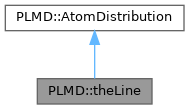
A wiggly line of atoms.
More...
|
| void | frame (std::vector< Vector > &posToUpdate, std::vector< double > &box, unsigned step, Random &rng) |
| | Update the input vectors with the position and the box of the frame.
|
| |
| void | frame (View< Vector > posToUpdate, View< double, 9 > box, unsigned, Random &) override |
| | Update the input vectors with the position and the box of the frame.
|
| |
| virtual bool | overrideNat (unsigned &) |
| | If necessary changes the number of atoms, returns true if that number has been changed.
|
| |
|
| static constexpr auto | doc ="A line of atoms, that wiggles randomly at each step" |
| |
| static constexpr auto | id ="line" |
| |
◆ decorateAtomDistribution()
| std::unique_ptr< AtomDistribution > PLMD::AtomDistribution::decorateAtomDistribution |
( |
std::unique_ptr< AtomDistribution > && | ad, |
|
|
std::string_view | decoratorsDistr ) |
|
staticinherited |
◆ frame() [1/2]
| void PLMD::AtomDistribution::frame |
( |
std::vector< Vector > & | posToUpdate, |
|
|
std::vector< double > & | box, |
|
|
unsigned | step, |
|
|
Random & | rng ) |
|
inherited |
Update the input vectors with the position and the box of the frame.
◆ frame() [2/2]
| void PLMD::theLine::frame |
( |
View< Vector > | posToUpdate, |
|
|
View< double, 9 > | box, |
|
|
unsigned | step, |
|
|
Random & | rng ) |
|
inlineoverridevirtual |
◆ getAtomDistribution()
| std::unique_ptr< AtomDistribution > PLMD::AtomDistribution::getAtomDistribution |
( |
std::string_view | atomicDistr | ) |
|
|
staticinherited |
◆ getDecoratorsDocumentation()
◆ getDecoratorsList()
| std::vector< std::string > PLMD::AtomDistribution::getDecoratorsList |
( |
| ) |
|
|
staticinherited |
◆ getDistributionDocumentation()
◆ getDistributionList()
| std::vector< std::string > PLMD::AtomDistribution::getDistributionList |
( |
| ) |
|
|
staticinherited |
◆ overrideNat()
| virtual bool PLMD::AtomDistribution::overrideNat |
( |
unsigned & | | ) |
|
|
inlinevirtualinherited |
If necessary changes the number of atoms, returns true if that number has been changed.
This is used principally in the benchmark. All the atoms distributions usually acts all the atoms passed by the vector of positions, so this does not change the input
But the "reading file" ones will only work if the number of atoms is the same of the one in the file, so this set the input to that number
And in case of the ones that replicate the trajectory this multiplies the input by the number of replicated "systems" this this is needed to inform benchmark that if you asked for replicating N atoms X*Y*Z times it will need an array of N*X*Y*Z atoms Outside of the specific usecase of the benchmark this is less important, because replicate will generate the inner trjectory on a limited number of atoms and the it will replicate it
Reimplemented in PLMD::fileTraj, PLMD::fixedTrajectory, PLMD::forceBoxTrajectory, PLMD::repliedTrajectory, PLMD::scaledTrajectory, and PLMD::wiggleTrajectory.
◆ doc
| auto PLMD::theLine::doc ="A line of atoms, that wiggles randomly at each step" |
|
staticconstexpr |
◆ id
| auto PLMD::theLine::id ="line" |
|
staticconstexpr |
The documentation for this struct was generated from the following file:




 1.13.2